
The Pennsieve Ontology Browser
A set of standard biomedical vocabularies you can reuse across your workspace — to tag datasets and to define the allowed values for your metadata.
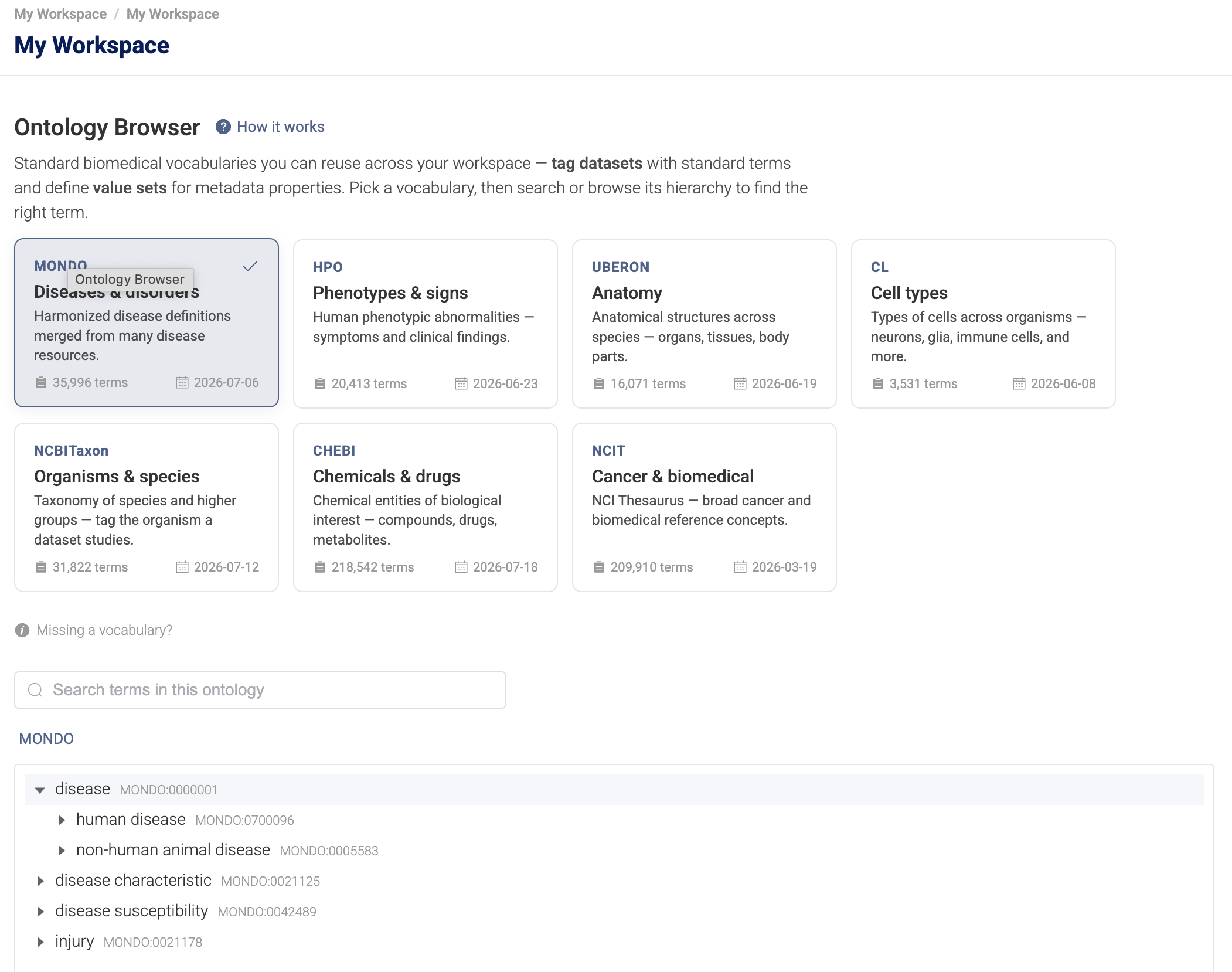
The Pennsieve Ontology Browser is an openly readable collection of standard biomedical vocabularies — shared, authoritative lists of terms for the things research describes: diseases, phenotypes, anatomy, cell types, organisms, and chemicals. Reusing a term from one of these vocabularies means you are describing your data with the same word, the same meaning, and the same stable identifier that other groups use — so datasets tagged or filled in independently line up instead of drifting into private, unmergeable labels.
What is an ontology?
An ontology is a standard vocabulary with structure. Beyond a flat list of words, each term carries:
- A stable identifier — a permanent code such as
MONDO:0005148that never changes, even if the display name is edited. - A name and synonyms — the preferred label plus the other ways people write it (so "T2DM" and "adult-onset diabetes" both find type 2 diabetes mellitus).
- A definition — what the term means, in agreed language.
- A place in a hierarchy — every term sits under broader ones and above narrower ones through is-a relationships (type 2 diabetes is a kind of diabetes, which is a kind of disease). This is what lets you move from general to specific, or gather a whole family of terms at once.
- Cross-references — links from a term to the equivalent code in other vocabularies, so a single tag can reach the codes another system expects.
Because everyone who reuses a term reuses the same identifier and meaning, ontologies are the practical mechanism behind consistent description: two datasets both tagged with epilepsy are genuinely about the same thing, without after-the-fact reconciliation.
The vocabularies
The browser covers the widely used, openly licensed biomedical ontologies, each focused on one kind of thing:
- MONDO — diseases and disorders.
- HPO — phenotypes: symptoms and clinical findings.
- UBERON — anatomy: organs, tissues, and body parts across species.
- Cell Ontology (CL) — cell types, from neurons to immune cells.
- NCBITaxon — organisms and species, for tagging what a dataset studies.
- ChEBI — chemicals: compounds, drugs, and metabolites.
- NCI Thesaurus (NCIt) — a broad cancer and biomedical reference vocabulary.
Standard units of measure (UCUM) are available to the platform in the same way, underpinning measurements.
How the vocabularies are kept current
The browser is not a live feed into each upstream project — it is a curated set of dated snapshots, published so that what you see is stable and traceable.
Published from the authoritative releases. Each vocabulary is built directly from its official public release. Only openly redistributable ontologies are included; vocabularies whose terms can't be freely republished (such as SNOMED CT) are not hosted here — but a term's cross-references still point you to those codes where you need them.
Refreshed on a schedule. Pennsieve rebuilds the vocabularies from their sources quarterly, so the catalog keeps pace with new terms without shifting under active work. Each vocabulary shows the version and release date it is currently on.
Snapshots are stable. Every refresh is published as a new, dated version; earlier versions are left unchanged. When you tag a dataset or define a value set, the term and the vocabulary version travel with it — so a later refresh adds newer terms for future use but never rewrites what you already recorded. Nothing you rely on changes underneath you.
If a vocabulary you need isn't covered, you can ask the Pennsieve team to add it.
Using ontology terms in your workspace
The same term serves two purposes, and both make your data easier to find and combine.
Tag datasets. Attach a standard term to a dataset to describe what it's about — the disease, organism, anatomy, or cell type it concerns. Because the tag is a shared term rather than free text, datasets from different groups become findable and comparable together, and searches for a broad term can surface everything filed under its narrower terms.
Define value sets in metadata models. In Pennsieve you describe your data with metadata models whose properties are the fields you record. You can bind a property to a branch of an ontology — a chosen term plus all of its narrower terms — and use that branch as the property's allowed values. Records are then filled in with consistent, standardized codes instead of ad-hoc text, and the platform can check that entered values fall within the branch.
This complements the CDE Catalog: CDEs standardize what you measure; ontology terms standardize the vocabulary you tag and answer with. Used together, the field and its values are both drawn from shared standards.
In short
- An ontology is a standard vocabulary of terms, each with a permanent identifier, a definition, synonyms, cross-references, and a place in a broader-to-narrower hierarchy.
- The browser covers the major openly licensed biomedical vocabularies (diseases, phenotypes, anatomy, cell types, organisms, chemicals), published as dated snapshots refreshed quarterly — new terms are added over time, and what you already recorded never changes.
- Reusing terms — to tag datasets and to define the allowed values for metadata properties — is what makes data described by different groups line up, be found, and be reused.
Updated about 2 months ago