
The Pennsieve CDE Catalog
A curated, versioned library of Common Data Elements you can attach to your metadata to make data findable, comparable, and reusable.
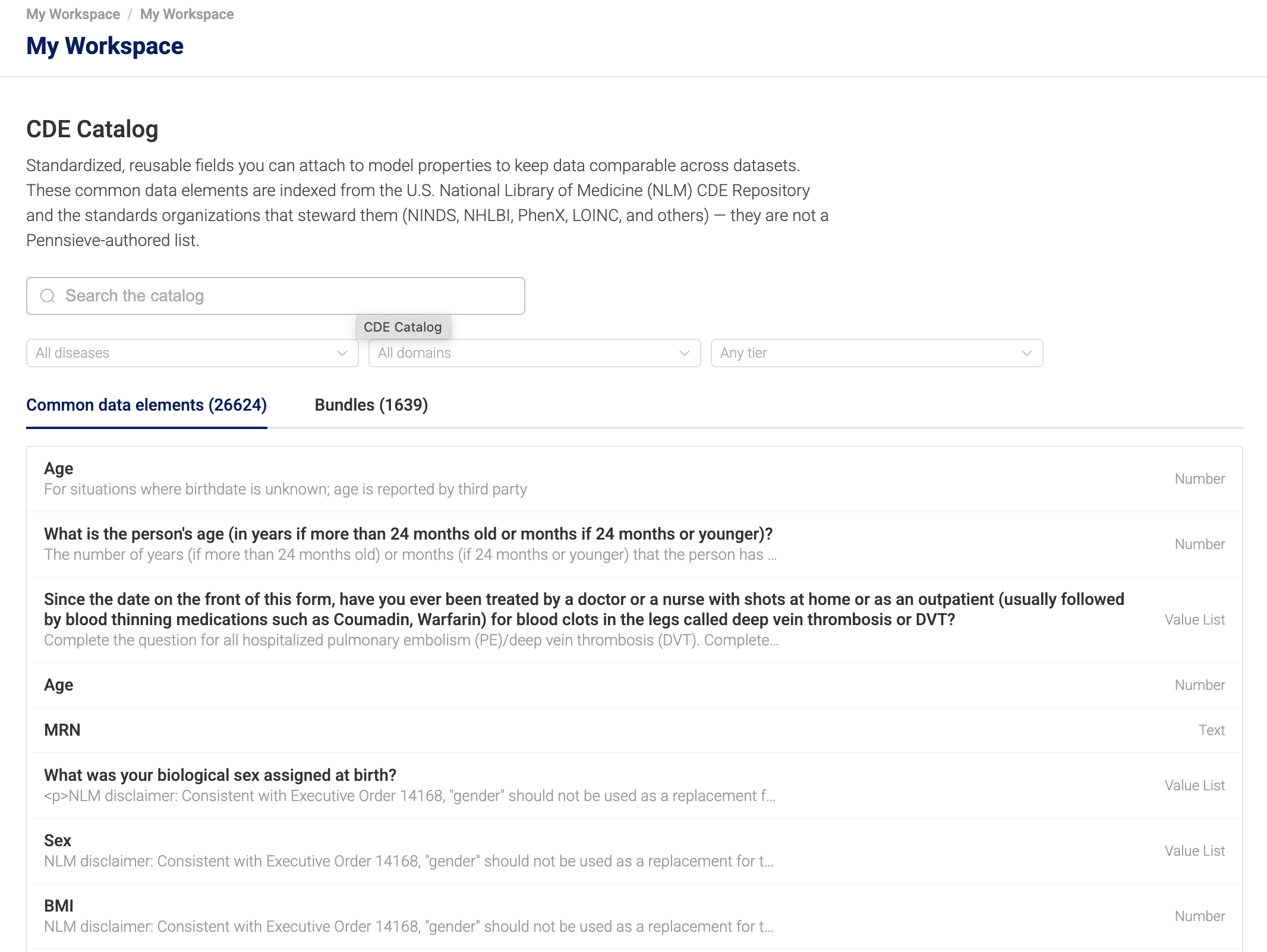
The Pennsieve CDE Catalog is a curated, openly readable library of Common Data Elements (CDEs) — standardized, reusable definitions for the individual pieces of data collected in research. Attaching a CDE to your metadata means you are describing your data with the same definition, the same allowed answers, and the same units that other groups use — so datasets that were collected independently can be compared, combined, and reused.
What is a Common Data Element?
A CDE is a precise, agreed-upon definition of a single thing you measure or record — for example, "Age at enrollment," "Seizure frequency," or "Handedness." Each CDE in the catalog carries:
- A name and definition — what the element means, in standardized language.
- A data type — number, date, free text, or a value list.
- Permissible values — for value lists, the exact set of allowed answers (e.g. Right / Left / Ambidextrous), often mapped to standard codes.
- A unit of measure — where applicable, expressed in standard units.
- Provenance — the authority that defined it (for example, the NIH's National Library of Medicine or the National Institute of Neurological Disorders and Stroke), a stable identifier, and a version.
Because everyone who uses a given CDE records the element the same way, CDEs are the practical mechanism behind harmonization: two studies that both use the "Handedness" CDE produce columns that line up without after-the-fact translation.
What is a bundle?
Some elements only make sense together. A measurement value and its unit, or the full set of questions on a clinical form, are meant to be captured as a set. In the catalog these sets are called bundles.
A bundle is simply a named group of CDEs that belong together — anything from a tight pair (a value + its unit) to a complete case report form with dozens or hundreds of elements. When you adopt a bundle, you get all of its member CDEs at once, in the intended order, so your metadata matches the established instrument rather than a partial or ad-hoc subset.
How the catalog snapshot is built
The catalog is not a single upstream feed — it is a curated snapshot assembled from several authoritative sources, published as a stable, versioned release. The process is designed so the catalog always reflects the most authoritative definition available, with full transparency about where each element came from.
Multiple sources, ranked by authority. The catalog draws from several sources — national CDE repositories, definitions taken directly from the steward organizations that author them, and Pennsieve-curated project contributions. Each source is assigned a priority rank.
The most authoritative source wins. The same element often appears in more than one source. When that happens, the catalog keeps one copy of the element — the one from the highest-ranked source — and sets the others aside. This matters in practice: a general repository may re-host a steward's elements but lag behind the steward's own updates, so a definition taken directly from the steward is ranked above the re-hosted copy and supersedes it. The same rule applies to bundles: the most authoritative version of a form replaces less complete or older copies rather than sitting alongside them. Curator corrections rank above all automated sources, so hand-verified edits are never overwritten by a later refresh.
Provenance and license are recorded, not assumed. Every element carries the source it came from, and every source records its license and attribution terms. Only openly redistributable content is published in the public catalog; anything whose terms are unclear is held back rather than guessed at.
Versions are immutable. Each time the catalog is rebuilt it is published as a new, dated version, and older versions are left unchanged. A reference to a CDE is pinned to a specific version, so it always resolves to exactly the definition that was in force when you used it — even after the catalog is refreshed. Nothing you rely on shifts underneath you.
The result is a single, de-duplicated, citable snapshot: one clear definition per element, each traceable to its source, stable over time.
Using CDEs to standardize your metadata
In Pennsieve you describe your data with metadata models whose properties are the fields you record. The CDE Catalog connects to that workflow directly: when you define a property, you can attach a CDE to it from the catalog.
Attaching a CDE does three things:
- Pins a stable reference. The property records the CDE's persistent identifier and version, so your metadata always points back to a specific, citable definition.
- Adopts the standard shape. The property takes on the CDE's data type, units, and — for value lists — its permissible values, so your records are captured in the agreed-upon form.
- Sets how strictly it applies. You choose a binding strength:
- Required — records must use the CDE's allowed values; entries outside the set are rejected.
- Preferred — the CDE's values are offered as guidance and autocomplete, but other entries are allowed.
- Example — the CDE is linked for reference only.
Attaching a bundle applies the same idea to a whole group at once: every member CDE is added to your model together, in order.
The payoff is cross-dataset comparability. When two datasets bind the same property to the same CDE, those columns share a name, a set of permissible values, and a unit — so combining or comparing them becomes a straightforward join on aligned values, with no bespoke mapping step. Standardizing at the point of description is what makes downstream data findable, interoperable, and reusable.
In short
- CDEs are standardized definitions for the individual things you record; bundles group the ones meant to be captured together.
- The catalog is a curated, versioned snapshot built by merging several sources in priority order — the most authoritative definition wins, provenance and license travel with every element, and published versions never change.
- Attaching CDEs to your metadata properties adopts those standards in your own data, which is what makes datasets from different groups line up and be reused.
Updated about 2 months ago